Monday, 10 February 2014

CHAPTER 9 : ENABLING THE ORGANIZATION-Decision Making


MAKING BUSINESS DECISION


THE DECISION-MAKING PROCESS

The process of making decisions plays a crucial role in communication and leadership for operational, managerial, and strategic projects.


THE SIX-STEP DECISION MAKING PROCESS


  1. Problem identification : Define the problem as clearly and precisely as possible.
  2. Data collection : Gather problem-related data, including who,what,where,when,why, and how. Be sure to gather facts, not rumors or opinions about the problem.
  3. Solution generation : Detail every solution possible, including ideas that seem farfetched.
  4. Solution test : Evaluate solutions in terms of feasibility (can it be completed?), suitability (is it a permanent or a temporary fix?), and acceptability (can all participants form a consensus?).
  5. Solution selection : Select the solution that best solves the problem and meets the needs of the business.
  6. Solution Implementation : If the solution solves the problem, then the decisions made were correct. If not, then the decision were incorrect and the process begins again.


DECISION-MAKING ESSENTIALS

  • A few key concepts about organizational structure will help our discussion of MIS decision-making tools. 
  • The structure of a typical organization is similar to a pyramid, and the different levels require different types of information to assist in decision making, problem solving, and opportunity capturing.


Operational
  •  At the operational level, employees develop, control, and maintain core business activities required to run the day-to-day operations.
  • Operational decisions are considered structured decisions, which arise in situations where established processes offer potential solutions.

Managerial
  • Emloyees are continuously  evaluating company operations to hone the firm's abilities to identify, adapt to, and leverage change.
  • these types of decision are considered semistructured decisions-occur in situations in which a few established processes help to evaluate potential solutions, but not enough to lead to a definite recommended decision.

Strategic

  • Managers develop overall business strategies, goals, and objectives as part of the company's strategic plan.
  • strategic decisions are highly unstructured decisions- occuring in situations which no procedures or rules exist to guide decision makers toward the correct choices.


ENHANCING DECISION MAKING WITH MIS

  • A model is a simplified representation or abstraction of reality.

OPERATIONAL SUPPORT SYSTEMS

  • Transactional information encompasses all the information contained within a single business process or unit of work.
  • Its primary purpose is to support the performance of daily operational or structured decisions.
Online transaction processing (OLTP) is the capture of transaction and event information using technology to:

  1. process the information according to defined business rules.
  2. store the information.
  3. update existing information to reflect the new information.

A transaction processing system (TPS) is the basic business system that serves the operational level (analysts) and assists in making structured decisions. 


MANAGERIAL SUPPORT SYSTEMS

Analytical information encompasses all organizational information.Its primary purpose is to support the performance of managerial analysis or semistructured decisions. Analytical information includes transactional information along with other information such as market and industry information.


Online analytical processing (OLAP) is the manipulation of information to create business intelligence in support of strategic decision making.


Decision support systems (DSSs) 
  • model information using OLAP, which provides assistance in evaluating and choosing among different courses of action.
  • DSSs enable high-level managers to examine and manipulate large amounts of detailed data from different internal and external sources.


What-if analysis

What-if analysis checks the impact of a change in a variable or assumption on the model.


Sensitivity analysis

Sensitivity analysis, a special case of what-if analysis, is the study of the impact on other variables when one variable is changed repeatedly.


Goal-Seeking analysis

Goal-seeking analysis finds the inputs necessary to achieve a goal such as a desired level of output.


Optimization analysis

Optimization analysis, an extension of goal-seeking analysis, finds the optimum value for a target variable by repeatedly changing other variables, subject to specified constraints.

By changing revenue and cost variables in an optimization analysis, managers can calculate the highest potential profits.

Constraints on revenue and cost variables can be taken into consideration, such as limits on the amount of raw materials the company can afford to purchase and limits on employees available to meet production needs.


STRATEGIC SUPPORT SYSTEMS

An executive information system (EIS) is a specialized DSS that supports senior-level executives and unstructured, long-term, nonroutine decisions requiring judgment, evaluation, and insight.


Glanularity refers to the level of detail
Sunday, 9 February 2014

CHAPTER 8 : ACCESSING ORGANIZATIONAL INFORMATION - DATA WAREHOUSE


DATA WAREHOUSE FUNDAMENTALS
A Data Warehouse -> a logical collection of information-gathered from many different operational data bases-that supports business analysis activities and decision-making task.

Primary Purpose : to aggregate information throughout an organization into a single repository in such a way that employees can make decisions and undertake business analysis activities.


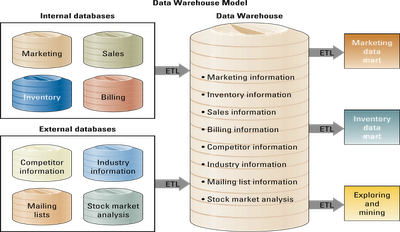
Extraction, Transformation, and Loading (ETL) : 

  • is a process that extracts information from internal and external databases, transforms the information using a common set of enterprise definitions, and loads the information into a data warehouse.
  • the data warehouse then sends subsets of the information to data marts.


A DATA MART

= contains a subset of data warehouse information. 
=to distinguish between data warehouses and data marts, think of data warehouse data as having more organizational focus and data marts as having focused information subsets particular to the needs of a given business unit.
=such as finance or production and operations.


DATA WAREHOUSE MODEL


MULTIDIMENSIONAL ANALYSIS AND DATA MINING


  • Relational databases contains information a series of two - dimensional tables
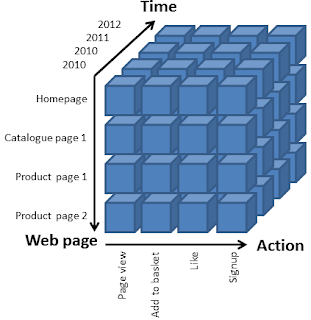
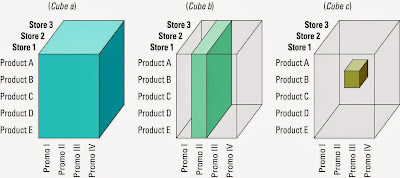
  • In a data warehouse and data mart, information is a multidimensional, it contains layers of columns and rows
  • Dimension- a particular attribute of information


Cube

= Common term for the representation of multidimensional information.


Data Mining 
= is the process of analyzing data to extract information not offered by the raw data alone. 


Data-mining tools
= use a variety of techniques to

Monday, 3 February 2014

CHAPTER 7 : Storing Organizational Information - DATABASES


Relational Databases Fundamentals

  • Information is stored in databases.
 DATABASES : maintains information about various types of subjects (inventory), events (transactions), people (employees), and places (warehouse).


Databases MODULES include :
  1. Hierarchical databases model - information is organized into a tree-like structure (using parent/child relationship) in such a way that it cannot have too many relationships.
  2. Network databases model - a flexible way of representing objects and their relationships.
  3. Relational databases model - stores information in the form of logically related two-dimensional tables.


ENTITIES AND ATTRIBUTES


Entity - is a person, place, thing, transaction or event about which information is stored.
Example : The rows in each table contain the entities.


Attributes - Characteristics of properties of an entity class.
                - The column in each table contain the attributes.


KEYS & RELATIONSHIPS


  • Primary keys and foreign keys identify the various entity classes in the databases.

1) Primary Key = A field that uniquely identifies a given entity in a table.
2) Foreign Key = A primary key of one table that appears an attribute in  another table and acts to provide a logical relationship among the two tables.


RELATIONAL DATABASES ADVANTAGES

Database advantages from a business perspective include:

Increase Flexibility

A well-designed database should:
  • Handle changes quickly and easily
  • Provide users with different views
  • Have only one physical view.
    physical view = deals with the physical storage of information on a storage device. e.g. hard disk.
  • Have multiple logical view.
    logical view = focuses on how users logically access information. e.g. A mail-order buss-2 people view different format but same physical view.


    Increase scaleability and performance

    A database must be scale to meet increased demand, while maintaining acceptable performance levels.

    a) Scalability - refers to how well a system can ad

Thursday, 16 January 2014

CHAPTER 6 : VALUING ORGANIZATIONAL INFORMATION


ORGANIZATIONAL INFORMATION

Organizational information comes at different levels and in different formats and "granularities".

Information granularities refers to the extent of detail within the information (fine and detailed or coarse and abstract). 

Employees must be able to correlate the different levels, formats, and granularities of information when making decisions.


THE VALUE OF TRANSACTIONAL  AND ANALYTICAL INFORMATION

Transactional information
  • encompasses all of the information contained within a single business process or unit of work, and its primary purpose is to support the performing of daily operational tasks.
    Example : withdrawing cash from an ATM, making an airline reservation, or purchasing stocks.

Analytical information

  • encompasses all organizational information, and its primary purpose is to support the performing of managerial analysis tasks. 
  • Analytical information includes transactional information along with other information such as market and industry information.
  • Example : trends, sales, product statistics and future growth projections.


THE VALUE OF TIMELY INFORMATION

Real-time information = immediate, up-to-date information.

Real-time systems = provide real-time information in response to query request.


THE VALUE OF QUALITY INFORMATION

five common characteristics of high-quality information:


Low-quality information example :


Recognizing how low-quality information issues occur will allow organizations to begin to correct them. The four primary sources of low-quality information are :

  1. Online customers intentionally enter inaccurate information to protect their privacy.
  2. Different systems have different information entry standards and formats.
  3. Call center operators enter abbreviated or erroneous information by accident or to save time.
  4. Third-party and external information contains inconsistencies, inaccuracies, and errors.


UNDERSTANDING THE COSTS OF POOR INFORMATION

Bad information can cause serious business ramifications such as:


  • Inability to accurately track customers, which directly affects strategic initiatives such as CRM and SCM.
  • Difficulty identifying the organization's most valuable customers.
  • Inability to identify selling opportunities and wasted revenue from marketing to nonexisting customers and nondeliverable mail.
  • Difficulty tracking revenue because of inaccurate invoices.
  • inability to build strong relationships with customers- which increases buyer power.


UNDERSTANDING THE BENEFITS OF GOOD INFORMATION

  • high quality information improve the chances of making good decision.
  • increase an organization's bottom line.
  • high quality information to make solid strategic business decision.


                  ******** END OF CHAPTER 6 ********


                                     THANK YOU ")

Wednesday, 15 January 2014

CHAPTER 5 : ORGANIZATIONAL STRUCTURES THAT SUPPORT STRATEGIC INITIATIVES


Organizational Structure


  • Employees across the organization must work closely together to develop strategic initiatives that create competitive advantages.
  • Understanding the basic structure of a typical IT department including titles, roles, and responsibilities will help an organization build a cohesive enetrpridewide team. 


IT Roles and Responsibilities
  • Information technology is a relatively new functional area, having been around formally in most organizations only for about 40 years.


Most organizations maintain positions such as:
  • Chief Executive Officer (CEO)
  • Chief Financial Officer (CFO)
  • Chief Operations Officer (COO)
There are more IT-related strategic positions such as :
  • Chief Information Officer (CIO)
  • Chief technology Officer (CTO)
  • Chief Security officer (CSO)
  • Chief Privacy Officer (CPO)
  • Chief knowledge Officer (CKO)


The chief information officer (CIO) is responsible for:
  1. overseeing all uses of information technology 
  2. ensuring the strategic alignment of IT with business goals and objectives.
the CIO often reports directly to the CEO. Broad functions of a CIO :
  1. Manager = ensure the delivery of all IT projects, on time and within budget.
  2. Leader = ensure the strategic vision of IT is in line with the strategic vision of the organization.
  3. Communicator = advocate and communicate the IT strategy by building and maintaining strong executive relationships.


The chief technology officer (CTO) is responsible for:
  1. ensuring the throughput, speed, accuracy, availability. and reliability of an organization's information technology.


The chief security officer (CSO) is responsible for:
  1. ensuring the security of IT systems and developing strategies and IT safeguards against attack from ha

Sunday, 12 January 2014

Chapter 4 : Measuring The Success of Strategic Initiatives


Measuring Information Technology's success


key performance indicators (KPIs)
  • the measure that are tied to business drivers. Metrics are the detailed measures that feed those KPIs.
  • Performance metrics fall into a nebulous area of business intelligence that is neither technology- nor business-centered, but this areas requires input from both IT and business professionals to find success.


Efficiency and Effectiveness


Benchmarking - Baseline Metrics

  • is a process of continuously measuring system results, comparing those results to optimal system performance (benchmark values), and identifying steps and procedures to improve system performance. 


The Interrelationships of Efficiency and Effectiveness IT Metrics

  • Efficiency IT metrics focus on the technology itself. 


  • Effectiveness IT metrics are determined according to an organization's goals, strategies, and objectives.


The interrelationships between Effeciency and Effectiveness


Metrics for strategic initiatives

  • A metric is nothing more than a standard measure to assess performance in a particular area.
  • metrics are at the heart of a good, customer-focused management system and any program directed at continuous improvement.
  • A focus on customers and performance standards shows up in the form of metrics that assess the ability to meet customer's needs and business objectives.

A few of the more common financial ratios include :
  1. Internal rate of return (IRR) = the rate at which the net present value of an investment equals zero.
  2. Return on investment (ROI) = indicates the earning power of a project and is measured by dividing the benefits of a project by the investment.
  3. Payback method = number of years to recoup the cost of an initiative based on projected annual net cash flow. 
  4. Break-even analysis = determines the volume of business requires to make a profit a  the current prices charged for the products or services.

Most managers are familiar with financial metrics but unfamiliar with information system metrics. The following metrics

Wednesday, 11 December 2013

CHAPTER 3... Strategic Initiatives for Implementing Competitive Advantage


STRATEGIC INITIATIVES

# Organizations can undertake high-profile strategic initiatives including: 

  • Supply Chain Management (SCM)
  • Customer Relatiionship Management (CRM)
  • Business Process Reengineering (BPR)
  • Enterprise Resource Planning (ERP)


SUPPLY CHAIN MANAGEMENT 
  • Supply Chain Management (SCM) - involves the management of information flows between and among stages in a supply chain to maximize total supply chain effectiveness and profitability.

4 BASIC COMPONENTS OF SUPPLY CHAIN MANAGEMENT :


* Wal-Mart and Procter & Gamble (P&G) SCM


SUPPLY CHAIN MANAGEMENT

  • Effectiveness and efficient SCM system can enable an organization to:


CUSTOMER RELATIONSHIP MANAGEMENT
  • CRM - involves managing all aspects of a customer's relationship with an organization to increase customer loyalty and retention and an organization's profitability.
  • Many organizations, such as Charles Schwab and Kaiser Permanente, have obtained great success through the implementation of CRM systems.
  • CRM is not just technology, but a strategy, process, and business goal that an organization must embrace on an enterprisewide level.


CRM OVERVIEW


REENGINEERING THE CORPORATION - book written by MICHAEL HAMMER and JAMES CHAMPY that recommends seven principles for BPR.


FINDING OPPORTUNITY USING BPR

  • A company can improve the way it travels